
A logistics manager at a mid-sized food company is looking at 6 pallets of refrigerated product and a delivery appointment 700 miles away.
A full reefer truckload would do it, and waste most of a trailer doing it. Dry LTL is out of the question, because the product has to stay at 34 degrees. And the one refrigerated carrier who quoted this lane last time isn't answering.
So the calling starts. One broker has a reefer, maybe, 2 days out. Another quotes a number that treats the temperature like a luxury feature. A third can move it today if the pallets can be ready in an hour, with a carrier nobody has worked with before, hauling product that becomes worthless if the unit fails and no one notices.
This load is the cold freight that falls between your contracts. Dry freight has the same problem with the loads too big for LTL and too small for a truck. Cold freight has the same gap, with one difference. When a dry load goes sideways, it arrives late. When a cold load goes sideways, it arrives ruined.
The gap between a reefer truckload and no good option at all
Freight procurement handles temperature the same way it handles size. Cleanly, at the extremes. Full reefer truckloads for the big cold freight. Ambient LTL for the small dry freight. Contracts, bids, and lanes that mostly behave.
The trouble is the middle. 4 to 12 pallets of refrigerated, frozen, or melt-risk product is a normal week for most food, beverage, and confection shippers. It's too small to fill a reefer trailer and too fragile to ride a dry one. Those lanes rarely go out to bid, because you can't bid an emergency and nobody plans for the half load. So the gap gets covered one call at a time, at whatever the day allows, by whoever says yes first.
Why a cold miss costs more than a late miss
On dry freight, the scramble costs money and hours. On cold freight, the scramble costs the product itself. A temperature excursion doesn't ask for a second chance. The receiver checks the pulp temperature at the dock, and the load either makes grade or it doesn't.
The costs stack in a particular order. The inflated spot rate for a reefer on short notice. The hours your team burns sourcing it. Then the downstream tier that dry freight never sees: the rejected load, the claim, the disposal, the short shipment to your customer, and the replacement order that ships expedited because now the shelf is empty. One warm trailer can erase the margin on a month of clean lanes.
And every scramble starts from zero. A refrigerated carrier you vetted in 4 minutes, hauling product where the vetting is the whole game.
What it means when the cold capacity is already built
There's a calmer way to handle the middle, and it's the same idea that anchors everything TSA builds. The capacity is already built.
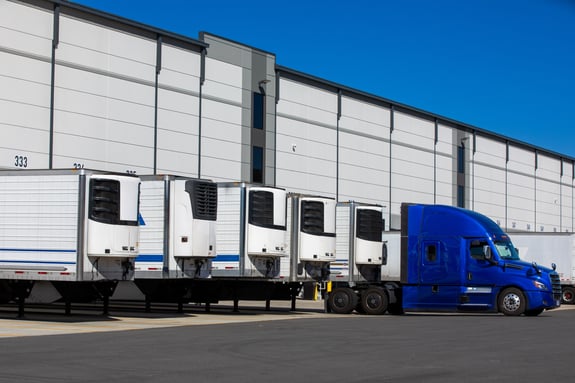
TSA is bringing its Reefer LTL program to the freight between a reefer truckload and no good option. Most loads move on consolidated multi-stop reefer trailers: temperature-controlled equipment that covers fresh and refrigerated product through frozen, down to minus 20 degrees, in every region. Every carrier clears the same 25-point vetting and freight security standard that TSA runs across truckload, drayage, LTL, and warehousing, and temperature records are available on request when a receiver asks.
The point of building the cold capacity early is the same as for any freight that falls between contracts. Instead of building a carrier relationship in the 4 minutes you don't have, you're calling a partner who already has the equipment, already knows the lane, and already treats your temperature spec as the load's first requirement.
What it means to own a cold outcome
Most logistics technology sells visibility. A portal, a map, a stream of updates. Useful, and TSA gives you that too, on its own TMS and client portal where you quote, book, and track in real time. But a tracking link doesn't keep anything cold. A status update tells you the load is warm. Accountability is the team that saw the risk coming, moved on it, and has the answer ready when you call.
TSA has been moving freight since 1984, and holds a 95 percent on-time pickup and delivery record across truckload, drayage, LTL, and warehousing. Freight still goes sideways every day. The record holds because someone owns the problem before it reaches you. That's the TSA Way. Transparency, Service, Accountability.
Where the cold gap bites hardest
- Fresh and refrigerated food, where a half load of refrigerated product with a DC appointment is a normal week.
- Frozen, where product waits in your freezer for a full truckload while the ship date slips.
- Confection and melt-risk goods, where summer turns every dry trailer into a gamble.
- Pharmaceuticals and other temperature-sensitive product, where the documentation matters as much as the degrees.
- Any shipper whose partials ride warm because there was no cold option their size.
4 signs your cold freight is leaking money
- Refrigerated or frozen partials wait for a full reefer truckload, and the ship date slips while they wait.
- Small cold loads ride ambient with ice packs and crossed fingers when the calendar gets tight.
- A temperature-related rejection, claim, or short shipment hit your customer in the last 2 quarters.
- Your team spends real time each week sourcing reefer capacity for loads that don't fit a contract.
If 2 or more of those sound familiar, the gap is quietly costing you money and shelf life.
Build the cold playbook before the next hot week
The fix is a plan for the cold freight you can't schedule. TSA starts with a free reefer lane analysis. You share 6 months of your refrigerated, frozen, and temperature-protect partial lanes. TSA returns a clear read on where the spend is leaking, where the temperature risk sits, and a recommended program. From there a pilot lane runs, and the relationship compounds on real freight.
The next 6 pallets at 34 degrees are already on their way to someone's desk. The only question is whether your team will be calling around for a reefer, or calling a partner who already has one on the way.
Ready to see your own numbers? Request a lane review and we will set up your reefer lane analysis.
COMMENTS